Leading ourselves with intention
Author: Becky Hain, Co-Founder, The Blurred Line
For many of us, “busy” has become our default. Striving is in human nature and achieving is a core part of our culture. We’re constantly adding and often jumping to the next thing.
And so many of us feel frazzled. Partly because we haven’t evolved to cope very well with the pace we live our lives. Our nervous systems aren’t designed for constant urgency and output, and yet, we keep adding more.
Recently, we’ve been supporting people to consider a version of ambition that they might have a better chance of sustaining.
Not the version a lot of us are used to where we keep squeezing more out of ourselves. Not achieving maximum “productivity” (whatever that looks like) but ambition that’s about alignment, to our capacity, our energy, defining success in a way that feels like ours. It can be a pretty confronting realisation that we’ve been working our ass off towards someone else’s idea of success.
When’s the last time you consciously defined success for yourself? When did you last revisit this?
My own idea of what success looks and feels like has changed multiple times. What mattered 10 years ago doesn’t look the same now.
As we move through stages, we change, we grow, and the weight we place on different outcomes changes too.
Most of us have used “traditional measures” of success. Productivity, status, output, salary. The external stuff.
Productivity is important but it can be easy to mistake busyness with effectiveness. Similarly, status can be validating but when it becomes the primary measure, often tied to other people’s opinions, it can leave you feeling slightly empty, even when you’re “doing well”.
Some considerations alongside the more traditional measures are:
How sustainable is your pace just now?
What gives you energy, and what is draining it?
Do you feel rested, healthy?
Do you feel connected to your work?
Are you growing and feeling stretched (in a good way)?
Are you living your values through your choices? Is this important to you?
Do you have space for family, creativity, rest?
Are you building trust and meaningful relationships?
The idea isn’t about adding pressure or feeling like you need to nail all these things, but checking in on them can help you notice how you’re feeling and offer direction when you need it.
Can we be more intentional about this direction? I recently read a quote that just made so much sense: “Habits keep us moving but intentions decide where we’re going.”
When we’re running on autopilot, we focus on what we’ve always done. We keep things moving but we don’t always stop to ask whether it still makes sense.
The Stress Curve is a well known model that shows how performance increases with pressure, up to a point. A bit of challenge sharpens focus. I definitely see that in myself when a deadline is approaching. But there’s a tipping point.
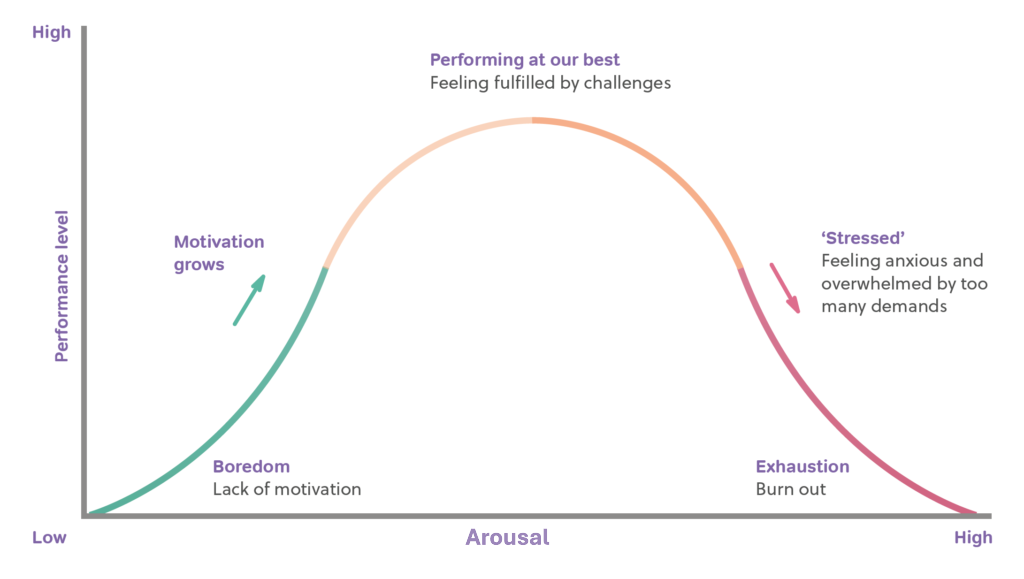
The Yerkes-Dodson Law (aka ‘Stress Curve’)
Arousal: physiological and psychological state of alertness and readiness to act
Image credit: Healthline.com
Too much stress, not enough recovery, and our performance drops. This often looks like foggy thinking, irritability, small mistakes starting to creep in, overwhelm and anxiety.
Sleep, health, hormones, environment, support can all influence what we realistically have capacity for on any given day. What felt manageable yesterday might not look the same today.
Because we often push through the warning signs, it can be useful to build awareness of what it feels like when you’re on the upward side of the curve and when you’re starting to slide down.
From a leadership perspective, expecting ourselves or our teams to constantly operate at the top of that curve comes at a cost.
The most supportive environments I’ve worked in are the ones where consideration of our wellbeing is encouraged, where setbacks aren’t penalised, where leaders understand that life happens outside of work, and trust you to manage your responsibilities within that. That powerful combination of autonomy and trust makes such a difference.
So, what can we do about it when life does feel a bit too full?
Chances are there’s a decent portion that is likely to be out of our control. A good place to start is identifying the bits that we can influence.
When we’re busy, the narrative we tell ourselves is “I’m too busy to rest.” But rest doesn’t have to mean clearing your calendar and heading off on a hike. It might mean switching to a less demanding task for a while, stepping outside for ten minutes, breaking a project into smaller pieces so it feels more manageable, or building a bit of space between commitments rather than rushing from one to the next.
Getting outside our heads, whether that’s writing things down or having a chat with a friend or colleague, can help to quieten the noise or lessen that feeling of carrying the weight alone.
Considering what energises us can be a game changer. Sometimes the activities that replenish us, a walk with a friend, going to the gym, being creative, are seen as “indulgence” and can be the first to go when we’re up against it.
These are just some of the things we can do to make the reality of living within this pace of life that little bit easier. Protecting ourselves so that how we show up is more intentional... along with some self-compassion for the inevitable messy bits too.